Hyponatremia in Congestive Heart Failure (CHF): Harnessing the Horse with Tolvaptan
DOI:
https://doi.org/10.53778/pjkd101350Paraules clau:
Tolvaptan, Hypervolemic hyponatremia, Congestive cardiac failutreResum
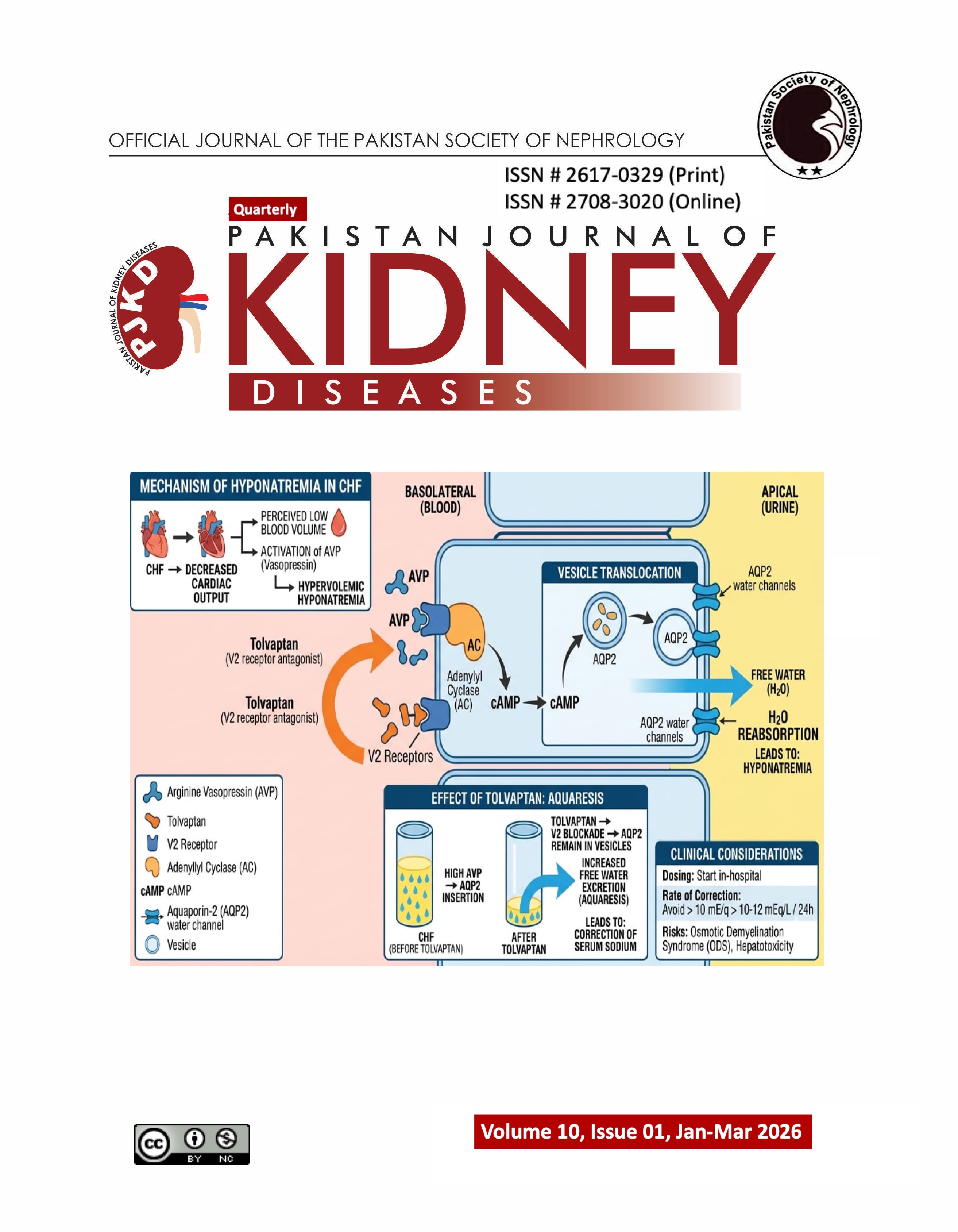
Hyponatremia in Congestive Heart Failure (CHF) is a complex and ominous clinical entity that transcends simple electrolyte imbalance. It serves as a profound indicator of advanced neurohormonal derangement and stands as one of the most reliable predictors of morbidity and mortality in the heart failure population [12, 20]. While traditional loop diuretics remain the cornerstone of decongestion, they frequently exacerbate hyponatremia by causing natriuresis and further activating the renin-angiotensin-aldosterone system (RAAS), leading to a state of "diuretic resistance" [5, 15]. Tolvaptan—an oral, selective vasopressin V_2-receptor antagonist—offers a physiologically targeted alternative. By inducing "aquaresis" (the excretion of solute-free water) rather than natriuresis, tolvaptan allows clinicians to "harness" the runaway vasopressin response [7, 18]. This article provides a comprehensive exploration of the pathophysiology of hypervolemic hyponatremia, the foundational clinical evidence supporting vaptan therapy, and a structured, safe approach to managing these high-risk patients
Referències
Konstam MA, Gheorghiade M, Burnett JC Jr, Grinfeld L, Maggioni AP, Swedberg K, et al. Effects of oral tolvaptan in patients hospitalized for worsening heart failure: the EVEREST Outcome Trial. JAMA. 2007;297(12):1319–1331.
Alawoad Z, Jensen J, Schou M, Ahmed N, Attia A, Rao S, Rahimi K, Wamil M. Redefining endpoints in heart failure clinical trials: the emerging role of wearable technologies in contemporary trial design. Heart Fail Rev. 2025;31(1):1. doi: 10.1007/s10741-025-10577-0.
Writing Committee Members; ACC/AHA Joint Committee Members. 2022 AHA/ACC/HFSA Guideline for the Management of Heart Failure. J Card Fail. 2022;28(5):e1-e167. doi: 10.1016/j.cardfail.2022.02.010.
Adler AJ, Verbalis JG. Disorders of water metabolism: hyponatremia and hypernatremia. In: Skorecki K, Chertow GM, Marsden PA, Taal MW, Yu ASL, editors. Brenner and Rector’s The Kidney. 12th ed. Philadelphia: Elsevier; 2024.p 540-594
Sterns, R. H. (2025). Disorders of Plasma Sodium — Causes, Consequences, and Correction. NEJM Evidence.
Mezzini G, Marasco S, Bertuccio A, Savioli G, Piccolella F, Racca F, Barbanera A, Vitali M. Hyponatremia Related to Neurocritical Care: Focus on Diagnosis and Therapy: A Systematic Review. Rev Recent Clin Trials. 2023;18(1):19-27. doi: 10.2174/1574887118666221208161259.
Shams E, Bonnice S, Mayrovitz HN. Diuretic resistance associated with heart failure. Cureus. 2022;14(1):e21369. doi:10.7759/cureus.21369.
Verbalis JG, Goldsmith SR, Greenberg A, Korzelius C, Schrier RW, Sterns RH, et al. Diagnosis, evaluation, and treatment of hyponatremia: expert panel recommendations. Am J Med. 2013;126(10 Suppl 1):S1–S42.
Goldsmith SR, Francis GS, Cowley AW Jr. Arginine vasopressin and the renal response to water loading in congestive heart failure. Am J Cardiol. 1986;58(3):295-9. doi: 10.1016/0002-9149(86)90065-2.
Rondon-Berrios H and Berl T. Vasopressin Receptor Antagonists in Hyponatremia: Uses and Misuses. Front. Med. 2017;4:141. doi: 10.3389/fmed.2017.00141
Wang C, Xiong B, Cai L. Effects of Tolvaptan in patients with acute heart failure: a systematic review and meta-analysis. BMC Cardiovasc Disord. 2017;17(1):164. doi: 10.1186/s12872-017-0598-y.
Wu L, Rodriguez M, El Hachem K, Krittanawong C. Diuretic Treatment in Heart Failure: A Practical Guide for Clinicians. Journal of Clinical Medicine. 2024;13(15):4470. https://doi.org/10.3390/jcm13154470
Manolis AA, Manolis TA, Manolis AS. Neurohumoral Activation in Heart Failure. International Journal of Molecular Sciences. 2023;24(20):15472. https://doi.org/10.3390/ijms242015472
Park HC, Oh YK, on behalf of Polycystic Kidney Disease Study Group. Practical Issues in the Management of Polycystic Kidney Disease: Blood Pressure and Water Balance. Electrolyte Blood Press. 2022;20(1):10-16. https://doi.org/10.5049/EBP.2022.20.1.10
Schrier RW, Gross P, Gheorghiade M, Berl T, Verbalis JG, Czerwiec FS, Orlandi C; SALT Investigators. Tolvaptan, a selective oral vasopressin V2-receptor antagonist, for hyponatremia. N Engl J Med. 2006;355(20):2099-112. doi: 10.1056/NEJMoa065181. Epub 2006 Nov 14. PMID: 17105757.
Berl T, Quittnat Pelletier F, Verbalis JG, Schrier RW, Bichet DG, Ouyang J, et al. Oral tolvaptan is safe and effective in chronic hyponatremia. J Am Soc Nephrol. 2010;21(4):705–12. doi:10.1681/ASN.2009080857.
Pratama V, Budiono J, Thobari JA, Widyantoro B, Anggraeni VY and Dinarti LK. The role of tolvaptan add-on therapy in patients with acute heart failure: a systematic review and network meta-analysis. Front. Cardiovasc. Med. 2024;11:1367442. doi: 10.3389/fcvm.2024.1367442
Uemura Y, Shibata R, Ishikawa S, Takemoto K, Murohara T, Watarai M. Initiation and long-term use of tolvaptan for patients with worsening heart failure through hospital and clinic cooperation. Nagoya J Med Sci. 2021;83(3):431-441. doi: 10.18999/nagjms.83.3.431.
Akram A, Muhammad US, Ali AM, Rizvi FM. Osmotic Demyelination Syndrome Following Rapid Correction of Hyponatremia in a Young Woman: A Case Report and Review of Literature. Cureus. 2025;17(6):e86452. doi: 10.7759/cureus.86452.
Descàrregues
Publicat
Número
Secció
Llicència
Drets d'autor (c) 2026 Chaudhry Adeel Ebad

Aquesta obra està sota una llicència internacional Creative Commons Reconeixement-NoComercial 4.0.