The KEEP Pakistan Initiative: Establishing a Kidney Early Evaluation Program in a Resource-Limited Setting — An Expert Survey and Proposed Framework
DOI:
https://doi.org/10.53778/pjkd103374Keywords:
KEEP, high risk population, screening, Pakistan, chronic kidney disease, epidemiology, preventionAbstract
Background: Chronic kidney disease is a major health burden all over the world including Pakistan where most of the cases remain undiagnosed at the community level. Kidney Early Evaluation Program (KEEP) in Pakistan offers a validated framework for target based community screening of kidney disease in resource limit settings.
Materials and methods: A structured questionnaire in the form of google form was sent to 24 medical experts. Respondents were asked to give their opinion and guidance about clinical and operational questions related to the implementation of KEEP initiative for early detection of chronic kidney disease in high risk population of Pakistan.
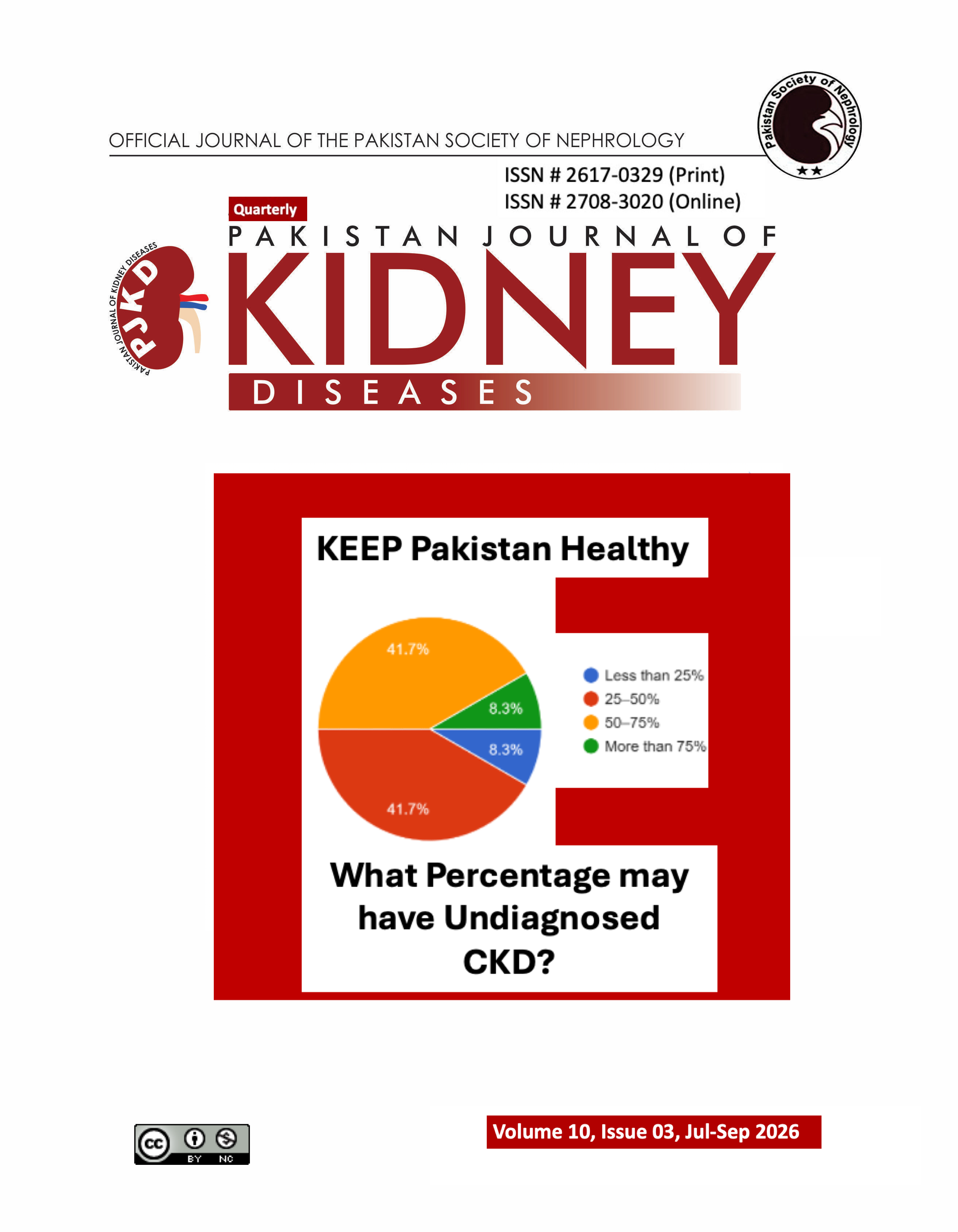
Results: About 80% of experts recommended chronic kidney disease screening using serum creatinine-based eGFR and spot urine albumin-to-creatinine ratio. Addition of urine complete examination for detecting glomerulonephritis was suggested by 70% experts, while 37% supported random blood sugar testing for diabetes screening. Most favored a combined screening strategy targeting high-risk groups, supported through sponsored funding. More than half also recommended screening individuals with recurrent kidney stones. Experts estimated that 40–50% of kidney disease cases remain undiagnosed in Pakistan. Most preferred screening in camps and hospital settings and were willing to participate in screening.
Conclusion: This survey provides us robust information about implementation of screening program for KEEP Pakistan. Targeting high risk individuals using a sponsored funded model for CKD screening is both feasible and urgently needed to address the silent epidemic of kidney disease in Pakistan.
References
1. Bikbov B, Purcell CA, Levey AS, et al. Global, regional, and national burden of chronic kidney disease, 1990–2017: a systematic analysis for the Global Burden of Disease Study 2017. The lancet 2020; 395: 709–733.
2. Cojuc-Konigsberg G, Guijosa A, Moscona-Nissan A, et al. Representation of low-and middle-income countries in CKD drug trials: a systematic review. American Journal of Kidney Diseases 2025; 85: 55-66. e1.
3. Foreman KJ, Marquez N, Dolgert A, et al. Forecasting life expectancy, years of life lost, and all-cause and cause-specific mortality for 250 causes of death: reference and alternative scenarios for 2016–40 for 195 countries and territories. The Lancet 2018; 392: 2052–2090.
4. Francis A, Harhay MN, Ong AC, et al. Chronic kidney disease and the global public health agenda: an international consensus. Nature Reviews Nephrology 2024; 20: 473–485.
5. Luyckx VA, Tuttle KR, Abdellatif D, et al. Mind the gap in kidney care: translating what we know into what we do. American Journal of Hypertension 2024; 37: 640–649.
6. Ndumele CE, Neeland IJ, Tuttle KR, et al. A synopsis of the evidence for the science and clinical management of cardiovascular-kidney-metabolic (CKM) syndrome: a scientific statement from the American Heart Association. Circulation 2023; 148: 1636–1664.
7. Stevens PE, Ahmed SB, Carrero JJ, et al. KDIGO 2024 clinical practice guideline for the evaluation and management of chronic kidney disease. Kidney international 2024; 105: S117–S314.
8. Guha C, Lopez-Vargas P, Ju A, et al. Patient needs and priorities for patient navigator programmes in chronic kidney disease: a workshop report. BMJ open 2020; 10: e040617.
9. Basit A, Fawwad A, Qureshi H, et al. Prevalence of diabetes, pre-diabetes and associated risk factors: second National Diabetes Survey of Pakistan (NDSP), 2016–2017. BMJ open 2018; 8: e020961.
10. Kearney PM, Whelton M, Reynolds K, et al. Global burden of hypertension: analysis of worldwide data. The lancet 2005; 365: 217–223.
11. Imtiaz S, Alam A. Epidemiology and demography of Chronic Kidney Disease in Pakistan-A review of Pakistani literature. Pakistan Journal of Kidney Diseases 2023; 7: 2–7.
12. Jessani S, Bux R, Jafar TH. Prevalence, determinants, and management of chronic kidney disease in Karachi, Pakistan-a community based cross-sectional study. BMC nephrology 2014; 15: 90.
13. Bello AK, Okpechi IG, Levin A, et al. An update on the global disparities in kidney disease burden and care across world countries and regions. The Lancet Global Health 2024; 12: e382–e395.
14. Whaley-Connell AT, Vassalotti JA, Collins AJ, et al. National Kidney Foundation’s Kidney Early Evaluation Program (KEEP) annual data report 2011: executive summary. American Journal of Kidney Diseases 2012; 59: S1–S4.
15. Levey AS, Becker C, Inker LA. Glomerular filtration rate and albuminuria for detection and staging of acute and chronic kidney disease in adults: a systematic review. Jama 2015; 313: 837–846.
16. Mahadevappa K, Nayak SB, Maharaj RG, et al. Using eGFR and Albumin Creatinine Ratio as an Initial Screening Tool in Trinidadian Primary Care to Identify High-risk Population for CKD: A Cross-Sectional Study. Indian Journal of Nephrology 2024; 34: 332.
17. Hamadah AM, Gharaibeh K, Mara KC, et al. Urinalysis for the diagnosis of glomerulonephritis: role of dysmorphic red blood cells. Nephrology Dialysis Transplantation 2018; 33: 1397–1403.
18. Delanghe J, Speeckaert M. Preanalytical requirements of urinalysis. Biochemia Medica 2014; 24: 89–104.
19. Vassalotti JA, Li S, McCullough PA, et al. Kidney early evaluation program: a community-based screening approach to address disparities in chronic kidney disease. In: Seminars in nephrology. Elsevier, 2010, pp. 66–73.
20. Ali M, Ahmed S, Ejaz A, et al. Prevalence of IgA Nephropathy: A 10 Years’ Experience from Jinnah Postgraduate Medical Centre, Karachi, Pakistan. Pakistan Journal of Medicine and Dentistry 2020; 9: 9–13.
21. Thomas MC, Brownlee M, Susztak K, et al. Diabetic kidney disease. Nature reviews Disease primers 2015; 1: 15018.
22. Association AD. Standards of medical care in diabetes—2022 abridged for primary care providers. Clinical Diabetes 2022; 40: 10–38.
23. Somannavar S, Ganesan A, Deepa M, et al. Random capillary blood glucose cut points for diabetes and pre-diabetes derived from community-based opportunistic screening in India. Diabetes care 2009; 32: 641–643.
24. Puavilai G, Kheesukapan P, Chanprasertyotin S, et al. Random capillary plasma glucose measurement in the screening of diabetes mellitus in high-risk subjects in Thailand. Diabetes research and clinical practice 2001; 51: 125–131.
25. Bhowmik B, Siddiquee T, Munir SB, et al. Random capillary blood glucose in the diagnosis of diabetes: a cross-sectional study in Bangladesh. BMJ open 2025; 15: e093938.
26. Xie Y, Bowe B, Mokdad AH, et al. Analysis of the Global Burden of Disease study highlights the global, regional, and national trends of chronic kidney disease epidemiology from 1990 to 2016. Kidney international 2018; 94: 567–581.
27. Harward DH, Bang H, Hu Y, et al. Evaluation of the SCORED questionnaire to identify individuals with chronic kidney disease in a community-based screening program in rural North Carolina. Journal of community medicine & health education 2014; 4: 007.
28. Francis A, Harhay MN, Ong AC, et al. Chronic kidney disease and the global public health agenda: an international consensus. Nature Reviews Nephrology 2024; 20: 473–485.
29. Chuang T-F, Hung H-C, Li S-F, et al. Risk of chronic kidney disease in patients with kidney stones—a nationwide cohort study. BMC nephrology 2020; 21: 292.
30. Rule AD, Bergstralh EJ, Melton III LJ, et al. Kidney stones and the risk for chronic kidney disease. Clinical Journal of the American Society of Nephrology 2009; 4: 804–811.
31. Shastri S, Patel J, Sambandam KK, et al. Kidney stone pathophysiology, evaluation and management: core curriculum 2023. American journal of kidney diseases 2023; 82: 617–634.
32. Hussain M, Somro AS, Abidi SS, et al. Stepping Stones In Prevention of Kidney Stone Disease In Pakistan. Pakistan Journal of Kidney Diseases 2024; 8: 2–10.
33. Imtiaz S. Strategies for preventing end stage kidney disease: The impact of kidney stone disease on Chronic Kidney Disease in Pakistan. JPMA The Journal of the Pakistan Medical Association.
34. Dhanorkar M, Prasad N, Kushwaha R, et al. Impact of early versus late referral to nephrologists on outcomes of chronic kidney disease patients in Northern India. International Journal of Nephrology 2022; 2022: 4768540.
35. Grill AK, Brimble S. Approach to the detection and management of chronic kidney disease: what primary care providers need to know. Canadian family physician 2018; 64: 728–735.
36. Chogtu B, Magazine R. Early referral in chronic kidney disease―seizing the opportunity. Clinical Epidemiology and Global Health 2024; 28: 101711.
37. Ramakrishnan C, Tan NC, Yoon S, et al. Healthcare professionals’ perspectives on facilitators of and barriers to CKD management in primary care: a qualitative study in Singapore clinics. BMC health services research 2022; 22: 560.
38. Brown WW, Peters RM, Ohmit SE, et al. Early detection of kidney disease in community settings: the Kidney Early Evaluation Program (KEEP). American Journal of Kidney Diseases 2003; 42: 22–35.
39. McCullough PA, Brown WW, Gannon MR, et al. Sustainable community-based CKD screening methods employed by the National Kidney Foundation’s Kidney Early Evaluation Program (KEEP). American Journal of Kidney Diseases 2011; 57: S4–S8.
Downloads
Published
Issue
Section
License
Copyright (c) 2026 Shafiq Ur Rehman Cheema, Dr. Faiza Muzahir, Dr. Nawal Chishti, Dr. Muhammad Ahmed Abubakar

This work is licensed under a Creative Commons Attribution-NonCommercial 4.0 International License.